You do not want a content strategy. You want sales. That is a fair thing to want.
And you already know how to push for them. Click Boost. Launch a campaign. Add budget. You can do it in minutes, even with a plain photo, a price, and a one-line caption, for ten products or for ten thousand.
The platform will happily deliver your ad. What it cannot do is make a stranger buy.
This article is about the part that decides that: what the person sees right after the click.
A note: Content is one factor. Product quality, price, delivery, and tracking matter too. The examples here are hypothetical illustrations, not client results.
The Boost Trap
Boosting is easy because it asks nothing of you. No goal, no plan, no test. You pick an audience and a budget and the post goes out.
But a boosted post is still just a post. If it was weak before the boost, you are now paying to show a weak post to more people.
Ads Manager gives you more control than the Boost button: objectives, audiences, placements, and conversion tracking. That control helps. It does not repair the content people land on. If you are still learning the basics, start with my guide to the top 5 Facebook ad mistakes beginners make.
What a Buyer Decides in a Few Seconds
Someone scrolls past your ad. They decide very quickly whether to stop. If they do, they ask silent questions:
What is this, exactly?
Is it for someone like me?
How much does it cost?
Can I trust this seller?
What if it does not fit or does not work?
How long will delivery take?
How do I order?
If the post answers none of these, they keep scrolling. You still paid to reach them.
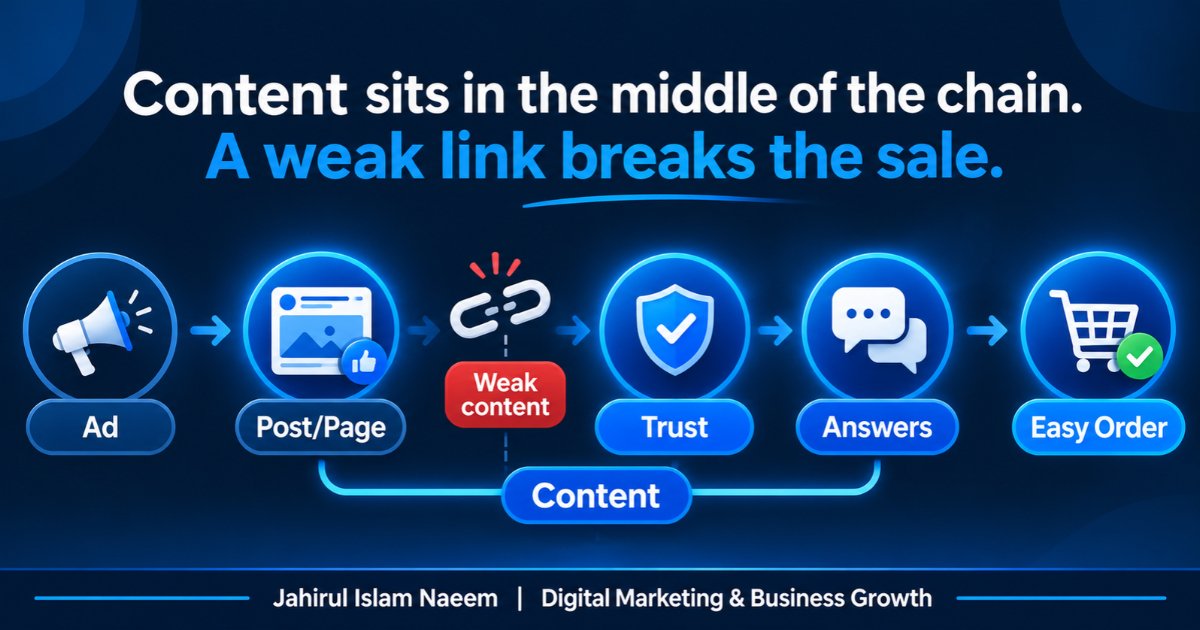
The Sales Chain
Think of every sale as a chain with five links:
Link | What it needs |
1. Ad | Stops the scroll with a clear product and reason |
2. Post or page | Shows the product clearly, with price and offer |
3. Trust | Reviews, real photos, proof that others bought |
4. Answers | Size, delivery, return, how it works |
5. Easy order | A clear next step: message, call, or order button |
Ads fix link one. Content fixes links two, three, and four. Your order process is link five. A weak link anywhere breaks the sale, and a bigger budget on link one does not strengthen the others.
A weak link two is often a page problem, not an ad problem. These 5 landing page mistakes that kill your conversions are the first thing I check.
Why Weak Content Can Make Ads More Expensive
Platforms generally reward ads that people engage with and act on. A weak creative tends to earn fewer clicks, messages, and orders for the same spend. That often means a higher cost per result.
The result varies by market and product, so treat this as a pattern to test, not a guarantee. The practical point is simple: improving the creative and the post is one of the few levers that can lower your cost per sale without raising your budget.
Make sure you can actually see that cost per sale. If tracking is not set up, read how to track conversions with Facebook Pixel and CAPI (no developer needed).
But I Have Thousands of Products
This is the real challenge for large catalogs. You cannot film a video and write a story for every item. You do not need to.
Use content in layers:
Layer 1: Best sellers get full content. Your top products deserve the best effort: a short demo video, real customer photos, reviews, and a clear answer to the top questions. These drive most of your ad spend, so they should have the strongest content.
Layer 2: Categories get shared content. Write one buying guide, size guide, or FAQ per category. “How to choose a running shoe” or “which phone case fits which model” helps every product in that group.
Layer 3: The long tail gets a clean template. For hundreds or thousands of items, consistency beats creativity. Use the same simple template: a clear photo, a plain product title, the price, one key detail, delivery info, and an order button. If you advertise through a catalog or shopping feed, product titles, images, and descriptions in the feed matter as much as the ad.
Layer 4: Reuse what customers give you. Customer questions become posts. Reviews become proof. Photos customers send, with permission, become content you did not have to produce.
Start with Layer 1. A small number of strong products can carry most of your results while you build out the rest.
Five Types of Content That Sell
You do not need to think about brand building. Think about what removes doubt:
1. Proof. Real reviews, customer photos, order packing videos, and delivered-order screenshots (with permission). Proof answers “can I trust this seller?”
2. Answers. Post the price, size, delivery time, return policy, and how to order. Most lost sales are lost to unanswered questions.
3. Demonstration. A short video showing the product in use. People who can see it work worry less.
4. Choice help. “Which one should I buy?” Comparisons and simple guides help buyers who are stuck between options.
5. A real offer with a real reason. A discount with a clear reason and an honest deadline gives people a reason to act now. Do not invent urgency.
[IMAGE 5: collage of the 5 content types. Alt text: “Five content types that remove buyer doubt”]
Weak Post vs Strong Post (Hypothetical Example)
Weak post | Strong post | |
Image | One flat product photo | Product in use, plus close-up |
Caption | “New arrival. Order now.” | What it is, who it is for, key benefit |
Price and offer | Missing or buried | Clear price and honest offer |
Proof | None | A real review or customer photo |
Questions | Left for DMs | Size, delivery, and return answered |
Next step | “Contact us” | “Message us to order” with a fast reply |
[IMAGE 6: side-by-side weak vs strong post mockup. Alt text: “Weak Facebook post compared with a strong Facebook post”]
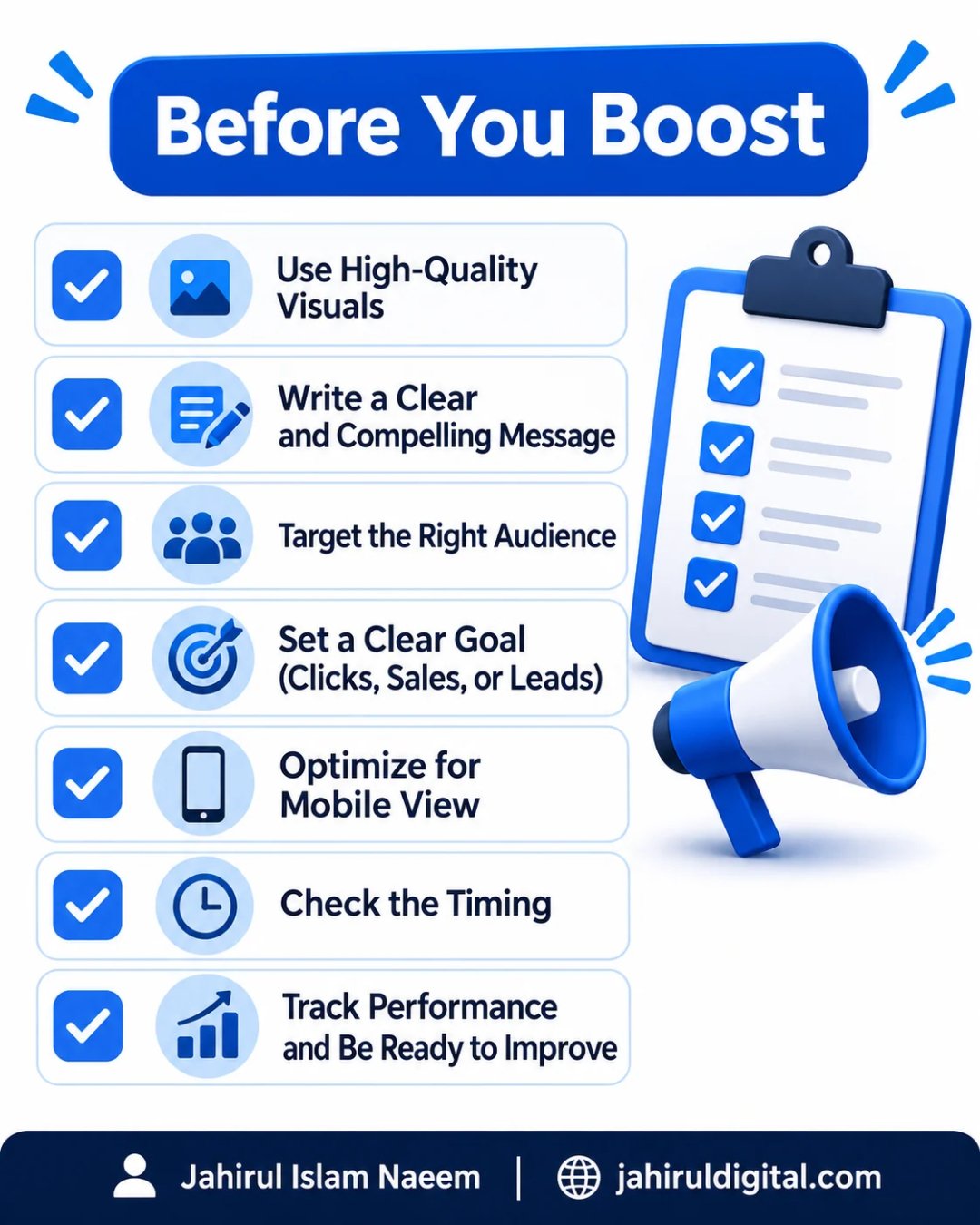
The 15-Minute Check Before You Boost
☐ Does the first image show the product clearly, ideally in use?
☐ Does the caption say what it is, who it is for, and the main benefit?
☐ Is the price visible without scrolling or asking?
☐ Is there at least one piece of real proof (review, customer photo, delivery screenshot)?
☐ Are size, delivery time, and return policy answered?
☐ Is the next step obvious: message, call, or order button?
☐ Will someone reply quickly after the click?
☐ Is tracking set up so you can measure cost per message or order?
If you cannot tick most of these, fix the post first. Then boost.
How to Test Without Guessing
Run two versions of the same post against the same audience for a few days. Keep everything else the same. Compare cost per message or per order. Keep the better one and test again.
Small tests like this tell you what your customers respond to, and they cost far less than scaling a weak post.
New to funnels? Here is what a marketing funnel is, with real examples for small businesses. If you want to see how structured testing can move an online store, read my eCommerce case study.
Common Mistakes
Boosting a post that never had a clear offer
Hiding the price to “create curiosity”
Sending buyers to a homepage instead of the product
Leaving size, delivery, and returns for the DMs
Using stock photos instead of real product photos
Inventing fake urgency or fake scarcity
Increasing budget before fixing the post
Replying to messages hours later
Running ads with no conversion tracking
Frequently Asked Questions
Why do my boosted posts get clicks but no sales? Common reasons are a weak post or page, unclear price or offer, missing proof, unanswered questions, or a slow order process. Check each link in the sales chain.
Is it better to boost a post or run a campaign in Ads Manager? Boosting is quick and simple. Campaigns in Ads Manager offer more control over objectives, audiences, placements, and tracking. For anything beyond a quick test, Ads Manager is usually the better tool.
How do I create content when I sell thousands of products? Work in layers: full content for best sellers, shared guides for categories, a clean template for the long tail, and reuse of customer reviews and questions.
Does better content really lower my cost per sale? It can, because stronger creative often earns more engagement and action for the same spend. Results vary, so test two versions and compare cost per result.
What should I fix first? Start with your best-selling products: make the post clear, add proof, answer the top questions, and make ordering easy. Then expand.
Want Me to Check Your Ads and Content?
I offer a free 30-minute check of your top products: the ad, the post or page people land on, and the path to order. I will point out what to fix first. No pitch, no obligation.
Book your free call at jahiruldigital.com
Related Reading
Google Ads for Small Businesses: Your First Profitable Campaign
Case Study: How I 4X’d an eCommerce Brand’s Sales in 30 Days
eCommerce work: Shadmart, Wings Eye, Gen Z E-Fashion, Popular Gadgets Bangladesh
About the Author
Jahirul Islam Naeem is a Digital Marketing & SEO Specialist who helps businesses grow through SEO, content strategy, analytics, conversion optimization, and data-driven digital marketing. He regularly writes about business growth, website strategy, and search marketing to help entrepreneurs build websites that generate measurable results.
Follow Jahirul: Facebook · LinkedIn · Instagram · X · YouTube · WhatsApp